
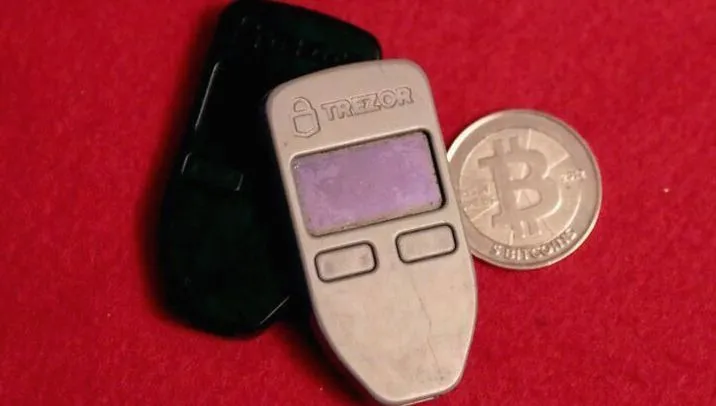
Trezor has lifted the maximum length of a wallet passphrase from 50 characters to 128, and it names the Coldcard thefts as the reason. The change shipped in the October Trezor Suite update, announced on 1 November by senior content marketer Henry Windle.
Trezor’s reasoning holds, but the dates in its account do not, and the defense it is extending is weaker than a bigger number suggests.
The Ceiling Went to 128, and Not on Every Device
Trezor’s longer limit applies to the Model T, Safe 3, Safe 5 and Safe 7. The Model One stays at 50 characters. Trezor users have to update device firmware to get it, and older firmware keeps the old cap.
A passphrase is not a PIN. It derives a separate wallet from the same backup, so a different passphrase opens a different wallet, and a mistyped one opens an empty wallet rather than an error message. Trezor’s own guide is blunt about the trade.
“Passphrases cannot be changed, removed, or recovered. If you lose your passphrase, you lose access to your passphrase wallet and its funds.”
The same Suite release added Arc accounts for USDC on Circle’s layer-1 network, Stellar Soroban token support, Cardano sending on mobile, and CSV export of trade history. The passphrase change is the one with a news hook attached.
Trezor Dates the Coldcard Flaw to July, but the Code Is From March 2021
Trezor’s post describes a July 2026 firmware flaw in some Coldcard devices that produced weak wallet backups attackers could recreate offline. July 2026 is when Coinkite disclosed the problem, on the 30th. It is not when the problem started.
The regression came from a commit dated 1 March 2021, according to Kevin Loaec of Wizard Sardine, who traced it through every affected release. Coldcard devices shipped with broken randomness for roughly five years before anyone noticed.
The failure came from a build setting, because a call to the hardware random number generator silently fell back to a software one while the compile-time guard meant to catch that used the wrong directive and never fired. Mk3 seeds ended up with about 40 bits of real randomness and Mk4, Mk5 and Q seeds with about 72. That is guessable. Attackers enumerated candidate seeds, derived the addresses and checked them against the chain, with no access to anyone’s device.
Fixes landed as 4.2.0 for the Mk2 and Mk3, 5.6.0 for the Mk4 and Mk5, and 1.5.0Q for the Q. None of them repair a seed that was already generated.
The total climbed $41 million in three days, which is why the figure quoted depends entirely on the day the source published. Source: Galaxy Research, Elliptic, Fortune · Chart: FinanceFeedsInvestor Takeaway
The Coldcard flaw shipped in March 2021 and was disclosed on 30 July 2026, so affected seeds were exposed for five years before the first fix.
A Longer Passphrase Buys Less Time Than the Number Implies
A passphrase did help some Coldcard owners, because an attacker needed the weak seed and the passphrase together. What the Trezor announcement leaves out is what that protection is worth, because the standard that turns a passphrase into a key is cheap to run.
BIP-39 derives the key with PBKDF2-HMAC-SHA512 at 2,048 iterations. Once an attacker holds the seed, testing each candidate passphrase costs almost nothing, so protection scales with how much genuine randomness the passphrase carries rather than how many characters it runs to. Loaec’s assessment was that for typical users a passphrase buys “hours or days at most,” and he advised against treating one as the fix for this bug.
A 128-character phrase a person can memorize may carry less entropy than 20 random characters from a generator, and that is what decides whether Trezor’s new ceiling helps. The cap removes a constraint. It does not supply the randomness.
Hardware wallets are the standard advice after an exchange failure, and that advice has been loud since Binance reopened withdrawals after a suspension it first put at about 48 hours, following a $6.3 billion theft whose attacker is still moving funds. Anyone comparing hardware wallet options this week is choosing between devices in a year that has logged 322 incidents and $8.73 billion of losses, and self-custody carried a nine-figure failure of its own before the exchange one.
Investor Takeaway
A 128-character passphrase only helps if it is randomly generated, because BIP-39’s 2,048-iteration derivation makes each guess cheap once the seed is known.